War of Attrition Between the United States and Iran: The Conflict Freezing Investments, Shipping and Real Estate Across the Gulf
Explosions in Tehran and Abu Dhabi Signal a New Era of Economic Paralysis in the Middle East

Trend reputazione
● in analisiThe growing war of attrition between the United States and Iran is no longer confined to military strategy, missile interceptions, or diplomatic pressure. It is rapidly transforming into a global economic shockwave capable of freezing investments, destabilizing financial markets, interrupting maritime logistics and damaging the long-term reputation of the Gulf region as one of the world’s safest hubs for international capital.
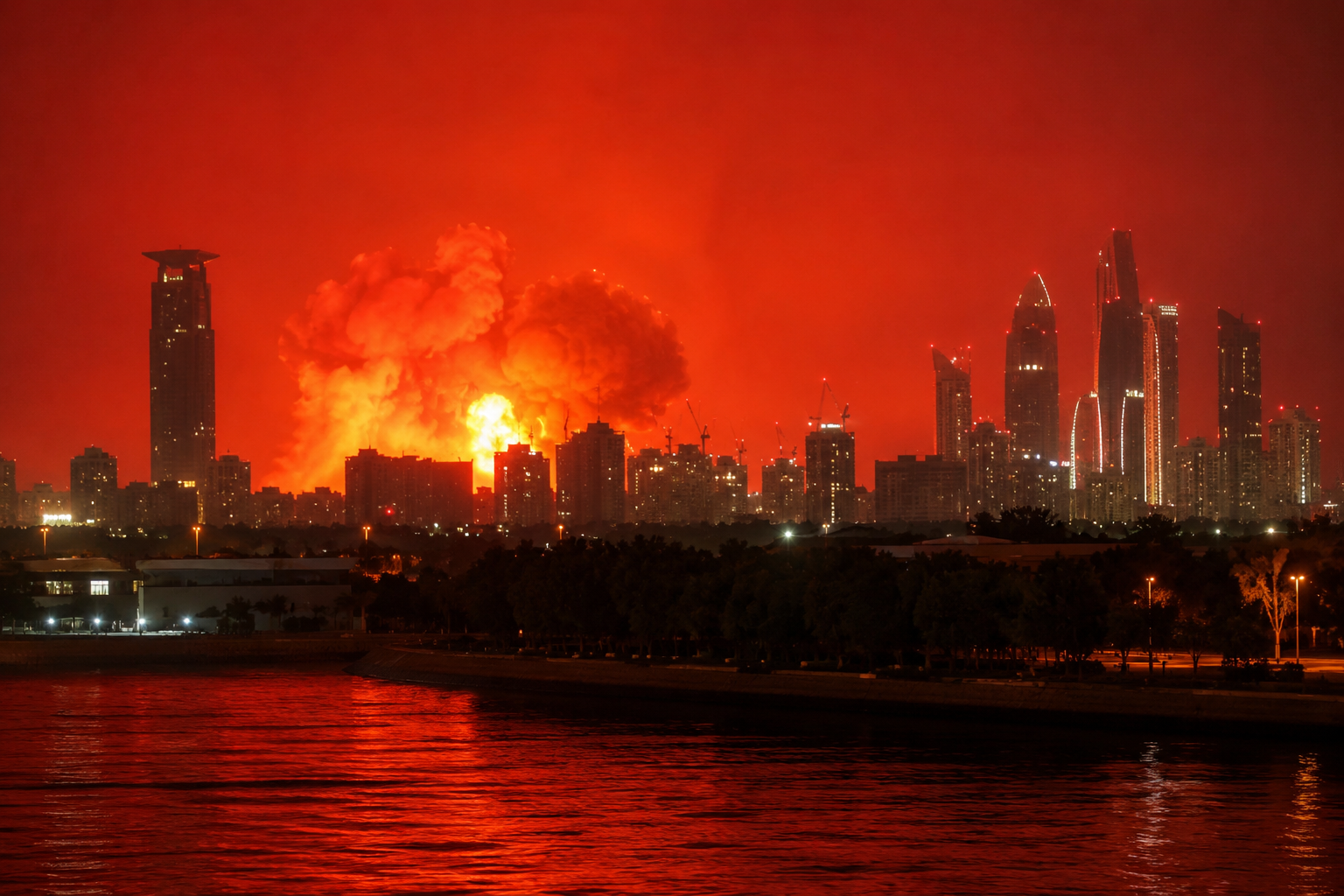
As explosions shake Tehran and Abu Dhabi, uncertainty spreads across global markets. The Strait of Hormuz, one of the most strategic maritime corridors on Earth, has become the center of a geopolitical standoff with consequences that extend far beyond the Middle East. Oil tankers remain trapped, insurance costs for maritime transport continue to rise, and multinational corporations are beginning to reassess their exposure to Gulf economies.
For years, cities such as Abu Dhabi and Dubai cultivated an international image based on stability, luxury, security and uninterrupted economic growth. Massive foreign investments flowed into real estate, tourism, finance, artificial intelligence, logistics and smart city infrastructure. The Gulf represented certainty in an unstable world. Today, however, the perception of risk is changing rapidly.
The explosions reported in Abu Dhabi are particularly symbolic because the Emirati capital has long positioned itself as a neutral financial fortress capable of remaining untouched by regional tensions. Even isolated security incidents can create powerful psychological effects on international investors. Global capital reacts not only to actual destruction, but to the perception of future instability. This is where reputational damage begins to emerge.
The crisis surrounding the Strait of Hormuz has become one of the most alarming elements of the conflict. Around a fifth of global oil shipments normally pass through this narrow maritime corridor. Thousands of vessels and tens of thousands of maritime workers are reportedly stranded while governments negotiate fragile agreements behind closed doors. Shipping companies now face escalating insurance premiums, operational delays and the possibility of direct military escalation involving drones, missiles and naval attacks.
The immediate economic consequences are already visible across multiple sectors. Fuel prices are under pressure, global logistics chains are slowing down, and commodity traders are entering defensive positions. But perhaps the most underestimated effect is the paralysis spreading across the Gulf real estate and investment market.
For nearly two decades, Abu Dhabi and Dubai became symbols of ultra-modern development and investor confidence. Luxury skyscrapers, offshore wealth structures, sovereign funds, international free zones and futuristic urban planning transformed the region into a magnet for billionaires, multinational corporations and global entrepreneurs. The perception of security was central to this success. Investors believed the Gulf could guarantee political continuity and economic resilience regardless of surrounding instability.
Now, that confidence faces one of its biggest tests in modern history.
Large investment funds are reportedly reviewing exposure to Gulf-based assets. International corporations dependent on uninterrupted shipping routes are beginning to consider contingency plans. Wealth managers are advising high-net-worth individuals to diversify assets geographically. Real estate developers fear that prolonged instability could slow demand from foreign buyers who previously viewed the Emirates as a secure long-term destination.
The psychological effect on the luxury property market could become severe if the conflict escalates further. Real estate thrives on predictability. Buyers investing millions into waterfront towers, branded residences or commercial hubs require long-term confidence in regional stability. Missile alerts, naval attacks and geopolitical uncertainty undermine precisely that foundation.
At the same time, tourism — another pillar of Gulf economies — faces growing pressure. Even if airports remain operational and daily life appears normal in many areas, international headlines shape traveler perception. Tourists do not distinguish between localized military incidents and broader regional instability. As global media circulate images of explosions, military mobilizations and naval tensions, booking trends may begin to weaken.
The situation also threatens major smart city and innovation projects that Gulf nations have spent years promoting globally. Countries across the region invested enormous resources into branding themselves as future-oriented technological powers capable of attracting startups, AI companies, fintech ecosystems and international talent. War introduces uncertainty into long-term innovation planning. Investors prefer ecosystems where infrastructure, regulations and supply chains remain stable for decades, not months.
The United States appears determined to apply maximum economic pressure on Tehran through a prolonged strategy of attrition. Intelligence estimates suggesting Iran may withstand the blockade for only a few months reveal the broader strategic objective: exhausting the Iranian economy while avoiding a full-scale conventional invasion. However, wars of economic exhaustion often generate collateral damage extending far beyond the original target.
Global energy markets are already reacting to every diplomatic rumor and every military incident. A single drone strike or naval confrontation inside Hormuz can trigger immediate fluctuations in oil prices worldwide. Inflationary fears may re-emerge across Europe and North America if maritime instability continues.
Meanwhile, Iran is attempting to reinforce its control over the Gulf narrative by proposing new mechanisms to regulate and tax ships passing through the Strait of Hormuz. Such measures are viewed by Western governments as unacceptable attempts to control international waters. Yet from Tehran’s perspective, the maritime corridor represents one of its few remaining strategic leverage points against international sanctions and military pressure.
The danger lies in the possibility that the conflict becomes normalized. A prolonged “frozen war” scenario — where negotiations continue while sporadic attacks persist — may create a permanent climate of uncertainty throughout the region. This type of instability is particularly destructive because it discourages long-term planning without necessarily triggering a definitive geopolitical resolution.
Financial institutions operating in the Gulf are now closely monitoring capital movement patterns. Some investors may delay acquisitions. Others could pause major construction projects or reduce exposure to sectors vulnerable to geopolitical shocks. Insurance companies, shipping operators and aviation firms are already recalculating risk models for the entire Middle East corridor.
Beyond economics, the reputational dimension of the crisis could become one of the most significant long-term consequences. Cities and nations spend decades building international trust, but reputational erosion can accelerate in a matter of weeks during geopolitical crises. The Gulf region built a global image associated with ambition, futuristic development and extraordinary security standards. Sustained military tension threatens to fracture that narrative.
For countries such as the United Arab Emirates, the challenge is not only preventing physical damage but preserving international confidence. Reputation itself has become a strategic asset. Investors today evaluate not only tax benefits and infrastructure quality, but geopolitical resilience, institutional predictability and perceived social stability.
The conflict also exposes the fragility of hyper-globalized economic systems dependent on narrow logistical chokepoints. Hormuz is not simply a regional passage; it is a critical artery for global commerce. Any disruption affects industries ranging from automotive manufacturing to aviation, chemicals, technology and energy-intensive sectors worldwide.
As negotiations continue behind diplomatic curtains, markets remain trapped between cautious optimism and fear of escalation. A temporary agreement could reopen maritime routes and restore partial confidence. Yet every new explosion, missile interception or naval confrontation pushes the region deeper into uncertainty.
The war between the United States and Iran is evolving into far more than a military confrontation. It is becoming a battle over economic endurance, strategic reputation and global perception. Abu Dhabi, Dubai, Tehran and the entire Gulf region now stand at the center of a geopolitical transformation whose consequences may redefine international investment flows for years to come.
In this new era, reputation, stability and trust are no longer abstract concepts. They have become the invisible infrastructure sustaining global economies. And once that infrastructure begins to crack, the effects can spread faster than any missile ever launched.
Domande frequenti
What is causing concern in Abu Dhabi’s real estate market?
Is Abu Dhabi’s real estate market collapsing?
Why are foreign investors worried about Abu Dhabi?
How could the Strait of Hormuz crisis affect property investments?
Are luxury properties in Abu Dhabi losing value?
Could tourism problems impact Abu Dhabi real estate?
Why is reputation important for Abu Dhabi’s economy?
Are companies delaying investments in the Gulf?
Can Abu Dhabi recover quickly from this crisis?
What is the biggest risk for Abu Dhabi’s real estate sector?
Cristian Nardi
Autore dell'articolo
Giornalista e scrittore appassionato di politica, tecnologia e società. Racconta storie con chiarezza e attenzione ai dettagli.
